
Deadline slippage isn’t just a delivery issue. In digital health projects, it can have real-world consequences for patients, clinicians and the wider system. Based on years leading transformation projects in healthcare and backed by current evidence and best practice, here are 7 practical ways to manage deadlines more effectively, along with free templates I’ve created to help you put them into action.
Why deadline management matters in healthcare
Healthcare projects often run in high-stakes, resource-constrained environments. A 2023 BMJ Open study found that poor project planning and inadequate time management are among the most common causes of delays in digital health implementations across the NHS. These delays don’t just affect project teams, they disrupt frontline services, reduce staff confidence in change, and ultimately compromise patient outcomes.
Yet we keep seeing the same challenges: unclear task ownership, last-minute firefighting, unrealistic timelines, and a lack of shared visibility. Most of these can be mitigated with clearer structures and better use of the tools already at our disposal.
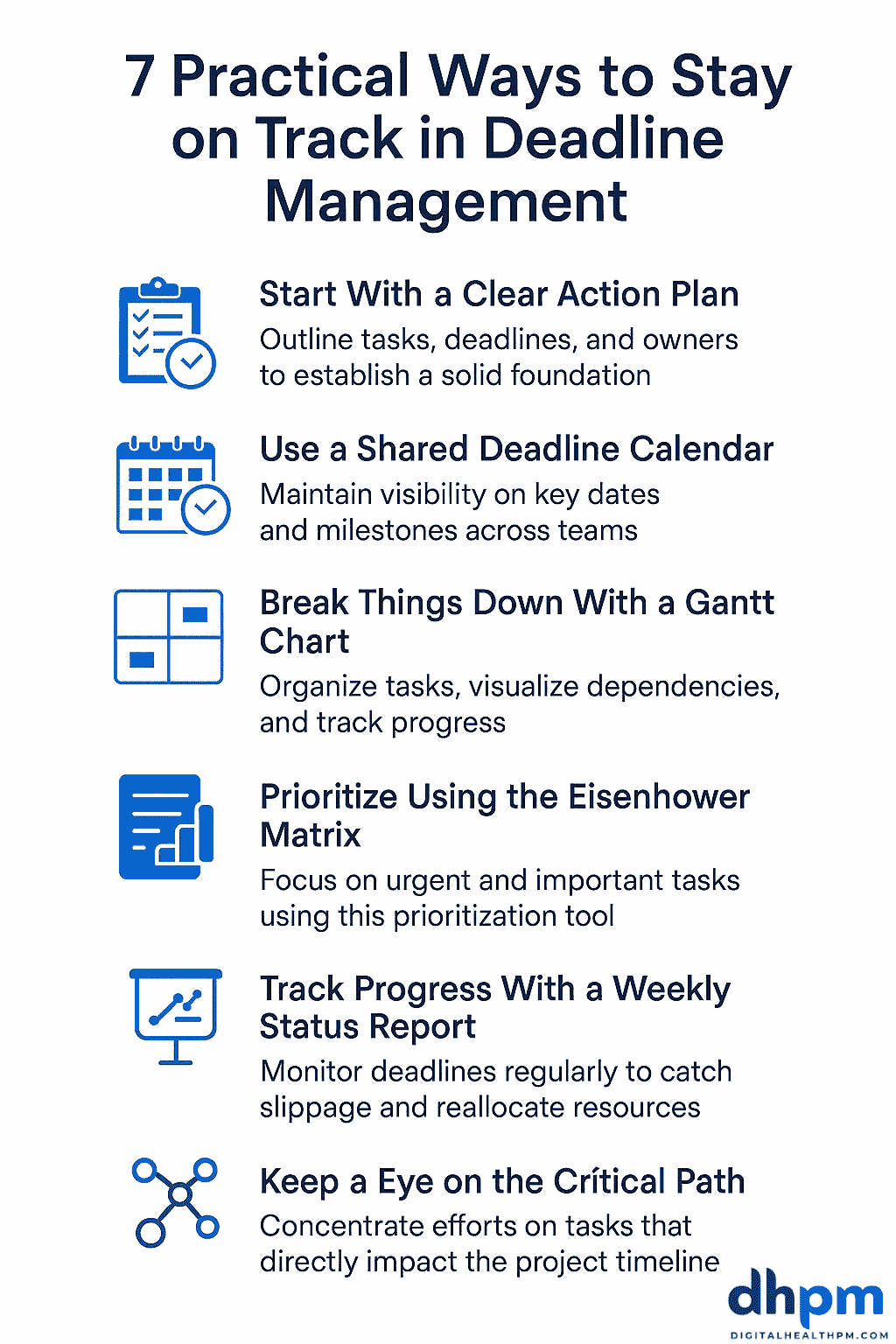
1. Start with a clear action plan
Before you touch a Gantt chart or send out invites for a kick-off, spend time writing a clear action plan. This should set out what needs to be done, by whom, and by when.
From experience, some projects often fall into the trap of “start fast, think later.” I once supported a project where the technical build had already started before anyone had agreed who was responsible for stakeholder mapping or clinical safety checks. We ended up burning weeks fixing things that could have been solved with a basic action plan in place.
To help you avoid that, I’ve developed a free Action Plan Template: simple, editable, and focused on delivery.
2. Use a shared deadline calendar
It sounds basic, but in multi-disciplinary projects with multiple moving parts, visibility is everything. A shared calendar that tracks go-live dates, critical milestones, and team availability helps everyone plan their work with context.
In the NHS, many teams already have access to Microsoft 365. Use Outlook or Teams Calendar to create a shared project timeline. For more agile-style projects, consider a visual calendar board using Planner or Trello.
3. Break things down with a Gantt chart
Gantt charts remain one of the most effective ways to manage deadlines, especially when used to visualise dependencies, track slippage, and monitor the critical path. But they’re often misused. Don’t treat your Gantt as a fancy list. Make it meaningful. Include dependencies. Mark key decision points. Keep it updated..
I’ve shared a clean, editable Gantt Chart Template that works well for clinical and operational project settings.
4. Prioritise using the Eisenhower Matrix
Not all tasks are equal, and in deadline management, knowing what to focus on is half the battle. The Eisenhower Matrix helps you distinguish between what’s urgent and what’s important, cutting through the noise of emails, requests and escalations.
Use it during planning sessions, stakeholder updates, or when your team feels overwhelmed. I’ve seen this method turn chaotic weekly meetings into focused, calm planning sessions. Especially useful when senior stakeholders are throwing “must-do” tasks your way.
To get started, download the Eisenhower Matrix Template, it’s printable or usable in Excel.
5. Track progress with a weekly status report
One of the most effective ways to stay on top of deadlines is to monitor them regularly. A simple status tracker helps you catch slippage early, reallocate resources, and keep everyone honest.
In previous roles, I’ve used a shared weekly tracker with RAG ratings and free-text comments. It made blockers visible and reduced the number of “I didn’t know it was delayed” conversations.
You can access my Status Report Template, designed for PMs who want a balance between structure and flexibility.
6. Keep an eye on the critical path
Some projects treat every task as equally urgent, when in reality, only a few directly determine the overall timeline. That’s your critical path. Delays here delay everything. Knowing your critical path helps you focus effort where it matters.
A 2022 International Journal of Project Management paper found that healthcare projects using critical path analysis were 35% more likely to deliver on time than those that didn’t. Yet from experience and observation, not many healthcare project teams use it, either due to lack of time, training or tools.
Your Gantt chart should flag this path. If it doesn’t, you can still map it manually using the action plan and dependency mapping. Focus your energy here. That’s where deadlines are made or missed.
7. Use digital tools at your disposal
You don’t need expensive project software to manage deadlines well. Most NHS staff already have access to Microsoft Excel, Teams, Outlook, and SharePoint. Combined, these give you calendars, Kanban-style boards, status trackers, and document sharing.
The key is to use them intentionally. A Planner board becomes your backlog. Excel becomes your Gantt. Outlook becomes your visibility hub. Don’t chase shiny tools if the basics can work — especially in cash-strapped NHS environments.
That said, if you are using more advanced tools (e.g. Asana, Monday.com or Smartsheet), many now come with AI-powered deadline forecasting, risk alerts and smart reminders. These can help larger-scale programmes or portfolios spot slippage early and take preventative action.
Deadline management in digital health isn’t about perfection —it’s about staying in control. With multiple teams, shifting priorities and real-world consequences, keeping delivery on track is essential to protecting both project integrity and patient care.
To help, I’ve shared a library of free project templates that I’ve used in real projects, including:
You can download them all from the Resources page.
And if you’d like help adapting them to your project, want a second opinion, or simply need to talk through a deadline challenge, get in touch. I’m always happy to connect with fellow NHS project leads, PMOs, and digital teams looking to deliver better, faster, and with less stress.
You can reach me directly here or connect via LinkedIn.
You don’t have to figure it all out alone.